Emergency Response Procedures
It is important to be prepared in advance so that you can act calmly in the event of an emergency, such as a sudden illness, injury, or disaster (traffic accidents, earthquakes, fires, floods, or other incidents).
In the event of an emergency, please follow the procedures outlined below to take immediate action and promptly contact the university to report the incident.
*If you encounter a situation not covered by items (1) through (5) that you cannot handle on your own, please consult with an academic advisor or a member of the Academic Affairs Office staff.
*When the university contacts individual students, it uses the information registered in the "KULAAS Academic Information System." If there are any changes to your address or phone number, please update your information in the system immediately.
| Category | Immediate response measures | Contact Information for Our University | |
|---|---|---|---|
| During working hours | Outside of working hours | ||
| (1) Sudden illness or injury | If the incident occurs on campus, contact the number listed on the right. If it occurs off-campus (e.g., in an apartment), call an ambulance following the instructions below. ○ Clearly state the reason for the call. ○ Provide the location. ○ Describe the patient’s condition, including whether they are conscious, breathing, or bleeding. | [Asakura Campus] Student Support Office (088-844-8149) [Oka-Toyo Campus] Student Affairs Office (088-880-2786) [Monobe Campus] Monobe General Affairs Office, Academic Affairs Section (088-864-5116) | 【朝倉・物部キャンパス】 警務員室 (088-844-8320) 【岡豊キャンパス】 医学部附属病院 事務当直室 (088-866-5815) |
| (2) Traffic Accidents | Saving lives is the top priority. Call 110 and 119 to request an ambulance. Even for minor injuries, notify 110 and your insurance company. | ||
| (3) Fire | Shout “Fire!” loudly to alert people nearby. Sound the fire alarm, attempt to extinguish the fire in its early stages, and call 119. ○ When using a fire extinguisher, aim directly at the source of the fire. ○ Cover the source of the fire with a blanket or similar item soaked thoroughly in water. ○ Dip a broom in water and beat the source of the fire with it. | ||
| (4) Earthquake | Put out any open flames and take cover under a desk or similar sturdy object. Wait until the shaking stops before evacuating outdoors. | Request to Register or Update Student Information (e.g., Current Address) The information registered in the "KULAAS Academic Information System," such as your current address, is used by the university to contact you or your family members, to verify your safety in the event of a disaster, and to respond to emergencies. We manage this information strictly as personal data. Failure to maintain contact during an emergency could result in serious harm to the student; therefore, if there are any changes to your registered information (such as your address or phone number), please update it immediately through the "KULAAS Academic Information System." | |
| (5) Wind and Water Damage | When a typhoon is approaching or heavy rain is expected, pay close attention to information on TV, radio, and other media. If an evacuation order is issued, extinguish any open flames, secure your home, and choose a safe route to evacuate to the designated location. | ||
| (6) Other | In cases of emergencies—such as maritime accidents or mountain rescues during extracurricular activities—where it is difficult to reach the scene by ambulance, calling 119 and providing a detailed report of the situation may result in the Fire Department dispatching a disaster relief helicopter (known as the "Ryoma" in Kochi Prefecture) for assistance, at their discretion. | ||
2019 Nankai Trough Earthquake Action Manual [PDF: 1.44 MB]
Confirming Evacuation Sites and Routes
Be sure to check evacuation sites and routes along your commute and in areas you frequently visit. Also, check your local government’s website to find the evacuation site closest to your home.
Your local municipality is also implementing earthquake preparedness measures, which are published in its newsletters and on its website. The phone numbers for the emergency response headquarters in Kochi City and Nankoku City are as follows:
Kochi City Regional Disaster Prevention Promotion Division
088-823-9040
Nankoku City Crisis Management Division
088-880-6575
About Disaster Preparedness Drills
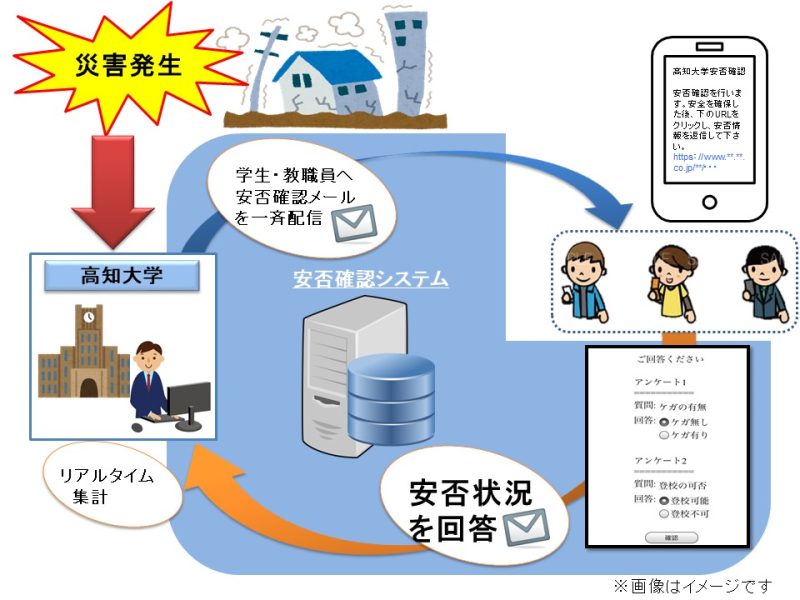
Every year, Kochi University conducts disaster preparedness and evacuation drills in which students and faculty members participate. Please make every effort to participate actively so that we can confirm the proper procedures to follow in the event of a disaster. Additionally, on the day of the drill, we will simultaneously conduct a test of the safety confirmation system by sending a safety confirmation email to all students and faculty members. If you receive this email, please reply promptly.
Registration for the Safety Check System
本学では、災害発生時(地震、台風等河川氾濫や土砂崩れ)における学部学生・大学院生及び教職員の安否確認の方法として、メールを利用した安否確認システムを導入しています。
This system is designed to enable the university to send a mass safety confirmation email to students’ pre-registered email addresses whenever it determines that a safety check is necessary. It then compiles the information regarding the extent of damage reported in the replies, which is used to facilitate the prompt implementation of disaster response measures and expedite recovery efforts.
Kochi University regularly sends out safety confirmation emails as part of disaster preparedness drills and other exercises. To ensure we are prepared for emergencies such as natural disasters, please be sure to reply to these emails.
In the event of a major disaster, if you receive a "safety confirmation email" from this system, please ensure your own safety first and then reply to confirm your status.
Please note that in the event of an emergency (such as a disaster), the recipient address (email address) for the safety confirmation emails sent to you via this system will be your university email address (e.g., b261g321@s.kochi-u.ac.jp).
Quick Tip
| A: Leave the bathwater in | It can be used for firefighting and for flushing the toilet. |
| B: Hang the flashlight | Immediately after an earthquake, the power goes out and it becomes completely dark. This is an essential disaster preparedness item to help prevent panic. |
| C: Turn on the emergency radio | To avoid being misled by false information and rumors, get accurate information. Call the information hotline at "171." |
| D: Securing an emergency water supply | There is a high likelihood of a water outage. Make sure to have at least a three-day supply on hand. |
| E: Be careful of the window glass | If window glass shatters, you won’t even be able to move. Keep a pair of sneakers in your bedroom and use heavy curtains. |
| F: Protect your head | Remove any large objects so they don’t fall while you’re sleeping. |
Japan Meteorological Agency Seismic Intensity Scale

Seismic Intensity 5- (Lower)
Many people find it difficult to move about. Furniture shifts, and dishes and books fall.
Seismic Intensity 5+
It’s terrifying. Unreinforced concrete block walls and vending machines are toppling over.

Seismic Intensity 6-
It becomes difficult to stand.
Wall tiles and window glass break, and some wooden buildings with low seismic resistance may collapse.

Intensity 6 Upper
You cannot move without holding on. Walls and windows in many buildings are damaged and fall; even reinforced concrete buildings may collapse.
Magnitude 7
Even highly earthquake-resistant buildings may tilt or sustain significant damage.
Ground fissures and landslides may occur.
- For inquiries regarding this matter
- Academic Affairs Division, Academic Affairs Section, University-wide and General Education Unit (Tel: 088-844-8706)
General Affairs Unit (Tel: 088-844-8144)