Assessment of Learning Outcomes
Grading
As a general rule, grades for courses are evaluated on a 100-point scale based on exams, reports, and other assignments conducted each semester. A score of 60 or higher is considered a passing grade, and credits are awarded. The grading criteria are outlined in the table below. Since grading methods vary by course, please check the “Grading Method” section of the syllabus. Some courses may be graded on a pass/fail basis.
Please note that all registered courses are subject to grading. Even in the following cases, grades will be assigned unless the course registration is canceled within the specified period.
① If eligibility requirements (attendance of at least two-thirds of class hours) are not met
② If the course is abandoned midway through the term
③ If the student is registered for the course but has not attended a single class
Grading Criteria
| Pass/Fail | Review | Rating | Criteria |
|---|---|---|---|
| Passed | Hide | 90–100 points | Achievements that demonstrate a thorough understanding and mastery of the knowledge, skills, and concepts outlined in the learning objectives, and that far exceed the standard level of achievement |
| Yu | 80–89 points | Achieving results that exceed the standard level of attainment, demonstrating a thorough understanding of the knowledge, skills, and concepts outlined in the learning objectives | |
| Good | 70–79 points | A grade indicating that the student has understood and grasped the knowledge, skills, and ways of thinking outlined in the learning objectives, is able to apply them to assigned tasks, and has achieved a level of proficiency generally considered standard. | |
| Yes | 60–69 points | A grade that indicates the student has understood and grasped the knowledge, skills, and ways of thinking outlined in the learning objectives, even though their performance falls below the standard level of achievement | |
| Failed | Not allowed | 59 points or less | Grades that indicate the student has not demonstrated an understanding or grasp of the knowledge, skills, and concepts outlined in the learning objectives, and are therefore deemed insufficient for earning course credit |
GPA
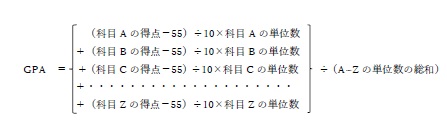
Our university uses the GPA (Grade Point Average) as one method of evaluating students' academic performance.While there are various methods for calculating GPA, our university uses a method called "functional GPA," which calculates the GPA for eligible courses using the following formula. However, for courses in which a student receives a failing grade of 59 points or less, the calculation "course score minus 55" is uniformly set to zero. Additionally, the GPA is rounded to the nearest hundredth.
履修登録単位の上限(医学部を除く)
(1) To ensure that students have sufficient time for preparatory and review work in both general education and major-specific courses, thereby enabling them to successfully complete their coursework, the university has set a maximum of 22 credits per semester. Students may not register for more than this limit.
However, for courses that do not count toward graduation requirements or are offered as intensive courses, students may register for them separately from the 22-credit limit, in accordance with separate regulations.
Note that for courses offered over multiple semesters, the number of credits for each semester is calculated by dividing the total number of credits for the course by the number of semesters in which it is offered.
Please note that credit transfer courses available at the Open University of Japan, Kochi Prefectural University, Kochi University of Technology, and Kochi National College of Technology are also subject to the registration limit.
(2) The maximum number of credits that can be registered applies to first- through third-year students. Fourth-year students are not subject to this limit. Even if a student takes a leave of absence, the maximum number of credits that can be registered no longer applies once they reach their fourth year.
(3) Special Provisions for Students with Outstanding Academic Performance
下記のアとイの条件を満たした成績優秀者は、「履修登録単位数の特例に関する申請書」を提出することにより履修登録単位数の上限を超えて履修登録することができます。申請手続は定められた期間内に学生サービスセンター学務課各学部教務担当又は物部キャンパス教務担当で行ってください。
申請の時期は、掲示によりお知らせします。
Criteria for Academic Excellence
ア.過去1年間に履修登録の上限単位数の単位数の対象となる科目(以下「対象科目」という。)を32単位以上修得していること。ただし,当該学期が本学に入学して最初の学期であった者については当該学期終了時に対象科目を16単位以上修得していることとし、過去1年間に休学、留学その他のやむを得ない事由によって通常の履修を行うことができない期間があったと学部教授会等が認める者については過去1年間において対象科目を16単位以上修得していることとする。
イ.過去1年間において成績評価された対象科目のGPAが、3.0以上であること。
Duration of Study and Graduation
本学学部の修業年限は4年(医学部医学科は6年)が必要です。卒業に必要な修得単位数は124単位以上(教育学部学校教育教員養成課程は137単位又は149単位以上、医学部医学科は206単位以上、医学部看護学科は128単位又は149単位以上)が必要です。
大学院修士課程及び専門職学位課程にあっては2年、博士課程にあっては3年(医学専攻は4年)の修業年限が必要です。また、各課程を修了するには、修士課程では、30単位以上を修得し、且つ、修士論文等が必要です。専門職学位課程では46単位の修得が必要です。博士課程では16単位以上(医学専攻は30単位以上)を修得し、且つ、博士論文が必要です。
For more details, please refer to the course catalog.