Kuroshio Region Seminar: "Adaptive Management of Deer and the Principles of the Wildlife Protection and Management Act"
Date:
Faculty is pleased to announce that we will be hosting a Kuroshio Region Seminar titled “Adaptive Management of Deer and the Principles of the Wildlife Protection and Management Act,” featuring Professor Hiroyuki Matsuda of Yokohama National University as the guest lecturer.
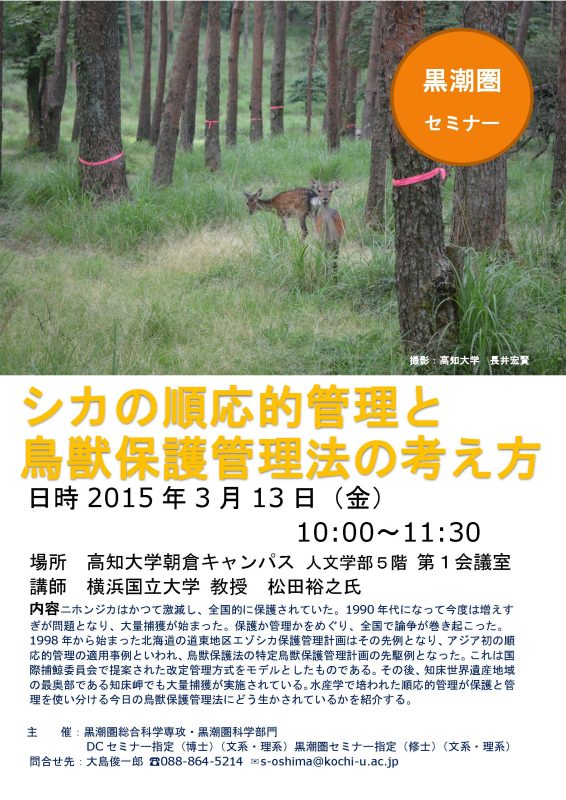
The Japanese deer population once declined sharply and was protected nationwide. By the 1990s, however, overpopulation had become a problem, leading to the start of large-scale culling. A nationwide debate erupted over whether to prioritize protection or management. The Ezo Deer Conservation and Management Plan for the Eastern Hokkaido region, launched in 1998, set a precedent; it is considered Asia’s first application of adaptive management and served as a pioneering example of a Specific Wildlife Conservation and Management Plan under the Wildlife Protection Act.This plan was modeled after the revised management approach proposed by the International Whaling Commission. Subsequently, large-scale culling has also been carried out at Cape Shiretoko, the deepest part of the Shiretoko World Heritage Site. This article explains how adaptive management, developed through fisheries science, is being applied in today’s Wildlife Protection and Management Act, which distinguishes between conservation and management.
We look forward to seeing many of you there.
[Date and Time] Friday, March 13, 2015, 10:00 a.m. – 11:30 a.m.
[Location] Asakura Campus, Faculty, 5th Floor, Conference Room 1
Contact: Faculty, Shunichiro Oshima
Phone: 088-864-5214
Email: s-oshima@kochi-u.ac.jp (Please replace “●” with “@” when sending.)
*If unavailable, please contact the Kuroshio Zone Office
Kuroshio Zone Office
Phone: 088-864-5786
Email: km03@kochi-u.ac.jp (Please replace "●" with "@" when sending.)