A research proposal submitted by Professor Masao Adachi (Faculty of Agriculture) has been selected for the Food Health Impact Assessment Technology Research program by the Food Safety Commission of the Cabinet Office.
Release Date:
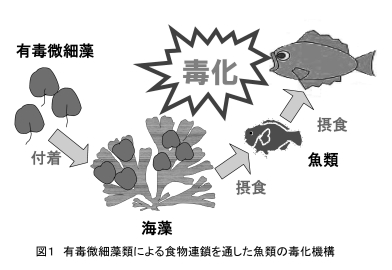
Ciguatera and paratoxin-like poisoning are considered the world’s most widespread forms of food poisoning, with the latter known for its high fatality rate. The toxins responsible for these poisonings are produced by microalgae and accumulate in fish that consume them through the food chain (Figure 1). In recent years, concerns have been raised that rising sea temperatures may lead to an expansion in the distribution and an increase in the abundance of toxic microalgae and poisoned fish. This study is the first to identify the algae and toxins responsible for the aforementioned food poisoning, which are spreading along the coasts of Honshu and Shikoku, and to accurately quantify them, thereby contributing to the reduction of food poisoning risks.
[Proposed Research Project]
Development of a Method for Assessing the Risk of Food Poisoning Caused by Tropical and Subtropical Fish Toxins in Japanese Coastal Waters
[Receiving Department / Principal Investigator]
Professor Masao Adachi, Department of Agriculture, Division of Natural Sciences, Faculty of Agriculture, Kochi University
[Business Overview]
Ciguatera and paratoxin-like poisoning, which have traditionally been associated with tropical and subtropical regions, are now occurring in Japan’s coastal waters as global warming accelerates, posing a significant food safety concern. The toxins responsible for these poisonings are believed to be produced by microalgae inhabiting coral reef areas and other similar environments.In this study, we will identify the primary microalgae responsible for these fish-borne toxicities in the waters of southern Japan—beginning with Tosa Bay in Kochi Prefecture, which can be considered the forefront of ocean warming—and develop methods for their quantification. Furthermore, by developing quantitative methods for the primary toxins contained in the causative algae and fish, we aim to establish risk assessment methods related to these toxicities and contribute to enhancing food safety.