An innovative collaborative research project aimed at developing new treatments and diagnostic tools in the field of autoimmune diseases has begun.
Release Date:
Professor Tetsuji Naka of the Center for Immunological and Intractable Diseases at Kochi University Hospital, along with Professor Tsutomu Takeuchi of the Department of Internal Medicine (Rheumatology and Collagen Diseases) and Professor Takanori Kanai of the Department of Internal Medicine (Gastroenterology) at Keio University School of Medicine, Project Leader Hiroshi Yamada of the Toxicogenomics and Informatics Project at the National Institute of Biomedical Innovation, Health and Nutrition, as well as Ono Pharmaceutical Co., Ltd., Daiichi Sankyo Co., Ltd.,Mitsubishi Tanabe Pharma Corporation.
This consortium targets immune-inflammatory diseases such as rheumatoid arthritis and ulcerative colitis. It represents an unprecedented form of collaborative research in which multiple academic institutions and competing pharmaceutical companies participate freely. By conducting detailed gene expression analyses based on high-quality clinical data, the consortium aims to develop new treatments and diagnostic methods for patients suffering from intractable immune-inflammatory diseases.
[Background]
In 2017, the Kochi University Hospital established the Center for Immune-Mediated and Inflammatory Diseases. The center has launched an initiative to specialize in the diagnosis and treatment of immune-mediated and inflammatory diseases—such as SLE (systemic lupus erythematosus)—by breaking down barriers between departments, including dermatology, respiratory medicine, ophthalmology, pediatrics, and cardiology.
Against this backdrop, by leveraging the high-level diagnostic, therapeutic, and clinical evaluation capabilities for immune-inflammatory intractable diseases available at Keio University Hospital—a “Center for Early and Exploratory Clinical Trials for Immune-Inflammatory Intractable Diseases” designated by the Ministry of Health, Labour and Welfare—we can jointly collect clinical specimens at specific time points before and after treatment interventions. By performing multi-omic analysis (Note 2) on these specimens by cell subset (Note 1), we can obtain a high-quality dataset unprecedented in scope.While Keio University Hospital will take the lead in collecting patient samples, human diseases are often significantly influenced by genetic and environmental factors, leading to regional variations. Therefore, the participation of Kochi University Hospital, which is deeply rooted in the local community, will help diversify the clinical sample set.Furthermore, the National Institute of Biomedical Innovation, Health and Nutrition (NIBIOHN), a drug discovery research institute under the jurisdiction of the Ministry of Health, Labour and Welfare, has established a state-of-the-art drug discovery research support system. Through this consortium’s joint research, we will analyze large-scale data obtained from tissue samples. At the same time, it is expected that personnel exchanges facilitated by the consortium will promote the development of young researchers and advance the standardization and improvement of diagnostic and therapeutic standards for immune-inflammatory intractable diseases.
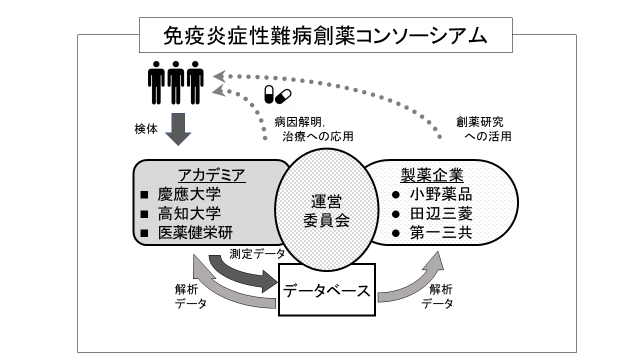
Given the limited number of clinical samples and the rising costs associated with basic research utilizing omics analysis technologies, it has become difficult to develop new drugs efficiently through the traditional one-on-one collaborative research models between academia and industry.To overcome these challenges, this consortium will involve multiple academic institutions in sample collection and analysis, with multiple pharmaceutical companies collaborating to provide funding up to the data acquisition stage. The resulting data will be shared among the consortium’s participating institutions. Based on this shared data, the consortium will operate under a unique industry-academia collaboration concept: pharmaceutical companies will conduct collaborative and competitive drug discovery research, while academic institutions will utilize the research results for further basic and applied research.
[Consortium Operations]
As of March 20, 2018, the participating organizations consist of the six institutions that expressed their intention to join at the time this consortium was conceived. A steering committee composed of members from each organization will be responsible for the operation and management of the consortium. Any future requests to join the consortium will be reviewed by the steering committee on an ongoing basis in accordance with the bylaws.
[Consortium Details]
① Name
Consortium for Drug Discovery for Immune-Inflammatory Intractable Diseases
② Research Period
5 years (FY2018–FY2022)
③ Consortium Location
Shinjuku-ku, Tokyo(Keio University Shinanomachi Campus)
④Participating Institutions
Keio University Hospital: Department of Rheumatology and Collagen Diseases, Department of Gastroenterology
Center for Immunology and Intractable Diseases, Kochi University Hospital
National Institute of Biomedical Innovation, Health and Nutrition: Toxicogenomics and Informatics Project
Ono Pharmaceutical Co., Ltd.
Daiichi Sankyo Co., Ltd.
Mitsubishi Tanabe Pharma Corporation
⑤ Target Diseases
Immune-mediated and inflammatory intractable diseases
(Schematic diagram of the consortium)
[Contact Information]
Center for Immunological and Intractable Diseases, Kochi University Hospital
Phone: 088-880-2719