◆Research findings by an international collaborative team led by Professor Yurika Ujiie of the International Research Institute for Marine Core Studies have been published in the journal *Environmental Pollution*
Release Date:
An international research team led by Professor Yurika Ujiie of the International Research Institute for Marine Core Studies has discovered a new biological purification mechanism that removes synthetic nanoparticles—a type of anthropogenic pollutant—from the environment. The findings were published in the journal *Environmental Pollution* on May 16, 2023.
Artificial nanoparticles are used in a wide range of applications, from everyday consumer goods to household appliances and industrial products. While their excellent physicochemical properties bring significant benefits to human society, waste containing artificial nanoparticles is discharged into soil and oceans, and their impact as a new type of environmental pollutant is drawing international attention. Among these, titanium dioxide nanoparticles rank second in global production volume, and it is estimated that they are already causing severe pollution in some coastal waters.In particular, they have been widely used in recent years as an ingredient in sunscreen, and the amount released into the environment is expected to continue increasing. However, due to their extremely small size, recovering these nanoparticles from the environment has not been easy.
In this study, Professor Yurika Ujiie and her team at the International Institute for Marine Core Research used foraminifera—single-celled eukaryotes—to elucidate the metabolic processes underlying the toxic effects of titanium dioxide nanoparticles. Furthermore, they discovered that foraminifera possess a unique ability to detoxify the toxicity of titanium dioxide nanoparticles and isolate them from the environment.
The findings and methodologies obtained in this study will serve as a foundation for future research into the cytotoxicity of nanoplastics and other synthetic nanoparticles. Furthermore, the bioremediation capabilities of foraminifera are expected to lead to environmental innovations, such as the recovery of synthetic nanoparticles.
This research was conducted by an international collaborative team led by the International Marine Core Research Center at Kochi University, the Japan Agency for Marine-Earth Science and Technology (JAMSTEC), and the University of Urbino in Italy. For more details, please visit the link below.
Title: Fascinating Strategies of Marine Benthic Organisms to Cope with an Emerging Pollutant: Titanium Dioxide Nanoparticles
Authors: Yoshiyuki Ishitani1, Caterina Ciacci2, Yurika Ujiie3, Akihiro Tomei4, Mattia Tiboni2, Goro Tanifuji5, Yuji Inagaki6, Fabrizio Frontalini2
1. Japan Agency for Marine-Earth Science and Technology, 2. University of Urbino, 3. International Marine Core Research Center, Kochi University, 4. Marine Work Japan, 5. National Museum of Nature and Science, 6. Research Center for Computational Science, University of Tsukuba
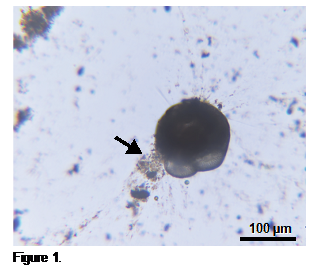
Foraminifera cultured long-term in a medium containing titanium dioxide nanoparticles. It was found that they secrete mucus (indicated by arrows) containing titanium outside the cell.