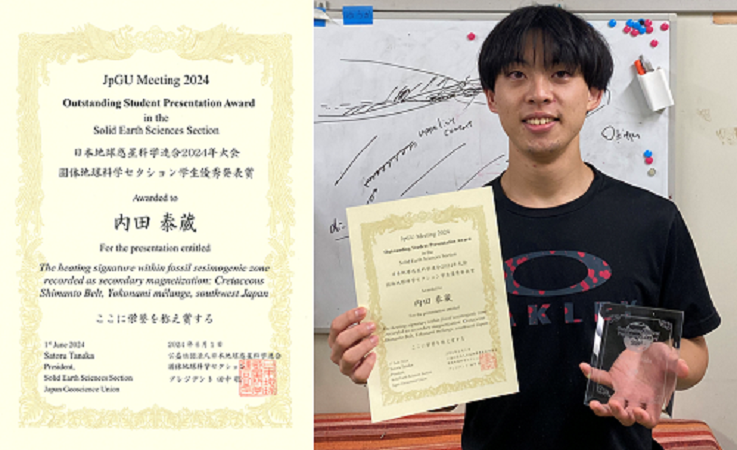
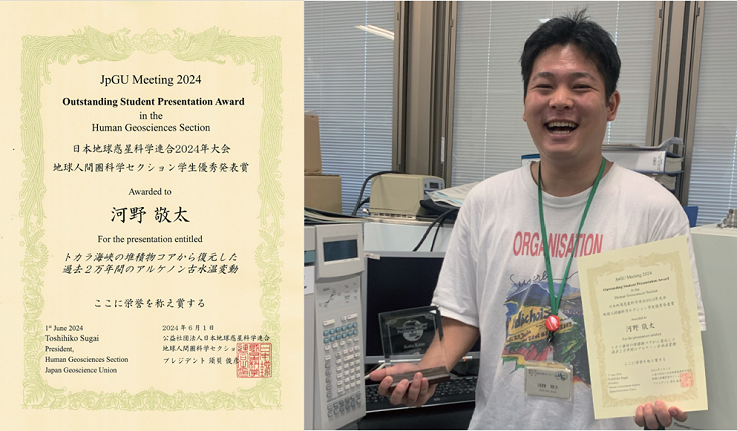
◆Taizo Uchida, a first-year graduate student in the Department of Applied Natural Sciences, and Keita Kono, a second-year graduate student in the Department of Science and Engineering, received the “Outstanding Student Presentation Award” at the 2024 Annual Meeting of the Japanese Geoscience Union.
Release Date:
The 2024 Annual Meeting of the Japanese Geoscience Union was held at Makuhari Messe in Chiba Prefecture from May 26 to 31, 2024, where Taizo Uchida, a first-year graduate student in the Department of Applied Natural Sciences, and Keita Kono, a second-year graduate student in the Department of Science and Engineering, received the “Outstanding Student Presentation Award.”
This award aims to encourage outstanding research presentations by students and improve their presentation skills. For the 2024 conference, presentations were evaluated in accordance with established guidelines from over 770 entries, and the top approximately 5–10% of presenters were selected in each of the five sections.
Mr. Uchida presented a paper titled “Heat History Recorded as Secondary Magnetization in Past Earthquake Faults: The Yokonami Melange of the Cretaceous Shimanto Belt in Southwest Japan,” in which he used paleomagnetism and rock magnetism to reveal the presence of localized heating along the northern margin fault of the Yokonami Melange of the Cretaceous Shimanto Belt, located in Tosa City, Kochi Prefecture.This indicates that seismic slip occurred along this fault and is expected to contribute to elucidating the mechanisms behind subduction zone earthquakes.
Dr. Kono presented a paper titled “Reconstruction of Past 20,000-Year Alkenone-Based Paleotemperature Variations from Sediment Cores in the Tokara Strait.” Through analysis of marine cores from the eastern Tokara Strait, he reconstructed surface water temperature variations in the Kuroshio Current over the past 20,000 years, revealing that temperatures had dropped by approximately 4°C during the Last Glacial Maximum and that these temperature changes mirrored those observed in high-latitude regions of the Northern Hemisphere.However, a temporary drop in water temperature was observed during the early Holocene, and it is expected that future research will clarify the relationship between this phenomenon and changes in precipitation resulting from the strengthening of the summer Asian monsoon at that time.
Each of these researchers received high praise for their work, which led to this award.