Marine Core Research Institute(MaCRI) Masao Adachi Faculty Sciences Marine Core Research Institute(MaCRI) Specially Appointed Lecturer Kyoko Hagino of Marine Core Research Institute(MaCRI) have been awarded the 2025 Newcomb-Cleveland Award by the American Association for the Advancement of Science
Release Date:
Professor Masao Adachi of the Department of Agricultural Sciences, Faculty of Natural Sciences ( Faculty), and Specially Appointed Lecturer Kyoko Hagino ( Marine Core Research Institute(MaCRI)) have been awarded the 2025 AAAS Newcomb Cleveland Prize. The award ceremony took place on February 14 (February 15, Japan time) at the AAAS Annual Meeting held in Boston, U.S.
The Newcomb-Cleveland Award is the oldest award of the American Association for the Advancement of Science, established in 1923 [1]. It is presented to all authors of research papers published in the Association’s scientific journal *Science* between June of one year and May of the following year that present data or theories making a significant contribution to the advancement of basic science, or technical achievements with broad impact.
Professor Adachi and Specially Appointed Lecturer Hagino, in collaboration with Professor Jonathan Zehr of the University of California, Santa Cruz, and others, received the award as co-authors of the paper “Nitrogen-fixing organelle in a marine alga”(published in the April 12, 2024 issue) [2,3].
This research is considered to be of paramount importance to the evolution of complex life; it provides insights into the evolution of organelles—a process believed to have occurred only a few times in the history of biology—and is recognized as a discovery that fundamentally broadens our understanding of cell biology, which led to the award.
・Professor Adachi
The discovery of nitroplastids in marine microalgae reported in this paper represents the identification of a new organelle following chloroplasts and mitochondria,and the elucidation of the role of these microalgae in the global marine nitrogen cycle. Furthermore, it holds the potential to lead to applied research related to the agricultural revolution, such as the creation of nitrogen-fixing plants through the elucidation of nitrogen fixation mechanisms in eukaryotes. It is deeply moving to reflect on how the knowledge and experience gained through many years of research on marine microalgae contributed to this discovery and ultimately led to this award.
・Hagino, Specially Appointed Lecturer
I am delighted that my research on B. bigelowii — which began 30 years ago as part of my graduation thesis in the Department of Earth Sciences at Kochi University ( Faculty)—has made significant progress thanks to encounters with many researchers, advances in science and technology, and collaborative research. Ultimately, this research has contributed to advances in basic science, such as studies on organelle formation, biological evolution, and the nitrogen cycle in the ocean. I would like to express my heartfelt gratitude to everyone and every research institution that has supported my research thus far.I hope to continue contributing to our understanding of biological evolution and marine ecosystems by advancing my research on B. bigelowii.
[1] American Association for the Advancement of Science Newcomb-Cleveland Award (English)
[2] American Association for the Advancement of Science: Explanation of the Award (English)
[3] Elucidating the progression of organelle formation (internalization as intracellular organelles) in nitrogen-fixing cyanobacteria within marine microalgae
htps://www.kochi-u.ac.jp/information/2024040100016/
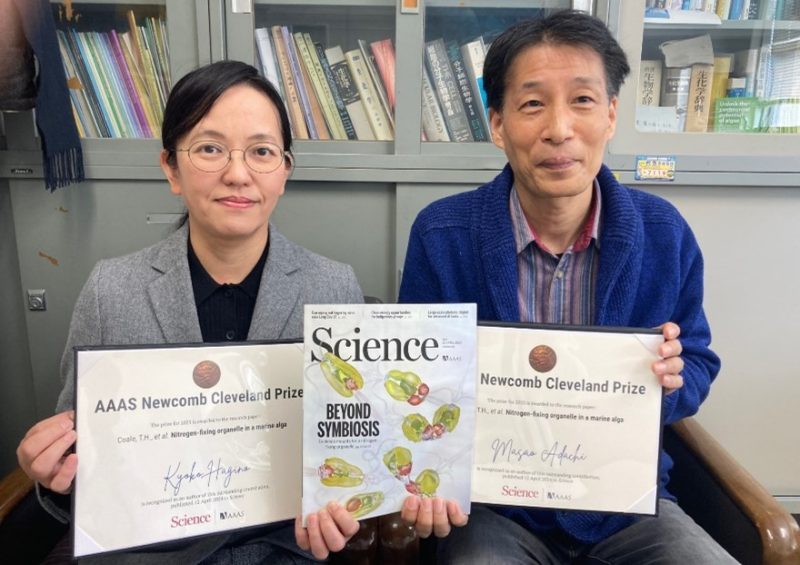
Special Lecturer Hagino and Professor Adachi holding the certificate and the issue of *Science* in which their paper was published
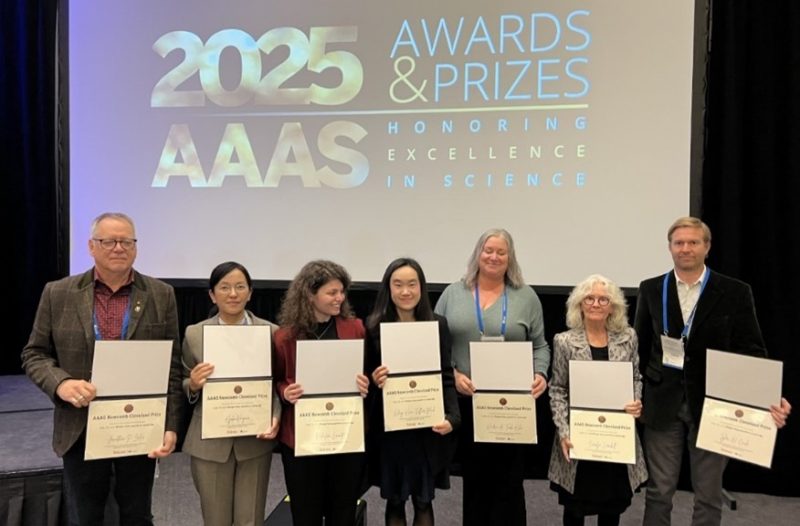
The award recipients who attended the ceremony held on February 14 (February 15 Japan Time). The second person from the left is Specially Appointed Lecturer Hagino.
[Contact Information for Inquiries Regarding This Matter]
Kochi University Public Relations and Alumni Affairs Office, Public Relations Section
TEL: 088-844-8643
E-mail: kh13@kochi-u.ac.jp