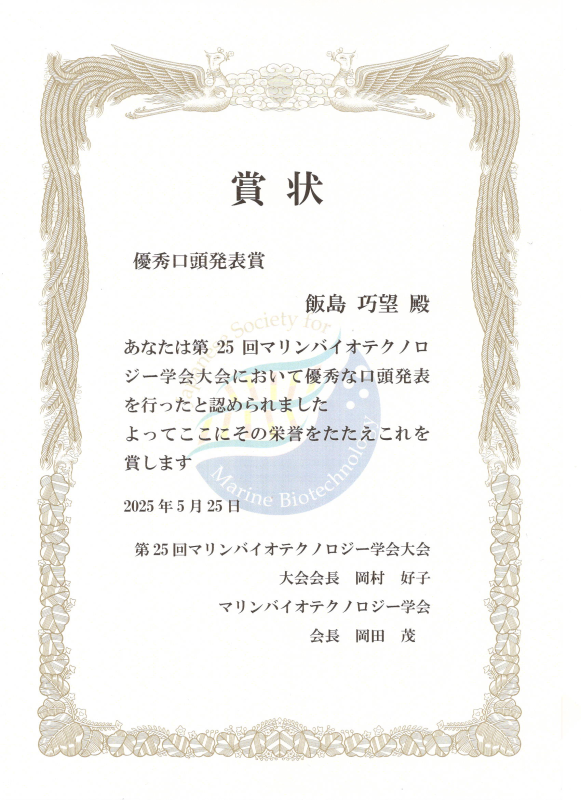
◆Takumu Iijima of the Joint Graduate School of Agricultural Sciences at Ehime University (affiliated with Kochi University) received the Outstanding Oral Presentation Award at the 25th Annual Meeting of the Society for Marine Biotechnology, held on May 24–25, 2025.
Release Date:
Takumu Iijima of the Joint Graduate School of Agricultural Sciences at Ehime University (affiliated with Kochi University) received the Outstanding Oral Presentation Award at the 25th Annual Meeting of the Society for Marine Biotechnology, held on May 24–25, 2025.
Tetrodotoxin (TTX), known as pufferfish toxin, has been detected in recent years in a succession of bivalves, such as scallops. Since bivalves are filter-feeding organisms that consume plankton, it is conceivable that organisms capable of harboring or producing TTX exist among the plankton they consume; therefore, identifying the specific plankton consumed by these bivalves is crucial.Metabarcoding—a method that involves PCR amplification of DNA from plankton found in the digestive tract of bivalves and subsequent analysis of the resulting amplified sequences—is useful for this purpose. However, during this process, DNA derived from the bivalves themselves is also amplified by PCR, which interferes with the analysis of the plankton.
As part of his doctoral thesis research, under the guidance of Professor Masao Adachi, Mr. Iijima focused on peptide nucleic acid (PNA) clamps—which inhibit the PCR amplification of specific DNA—and succeeded in developing a PNA clamp that completely suppresses the PCR amplification of scallop DNA while leaving the PCR amplification of plankton DNA unaffected.
Going forward, it is hoped that this PNA clamp will be used to comprehensively identify the plankton consumed by scallops and, from among them, pinpoint the organisms responsible for their toxicity.
Title: Development of a PNA clamp that specifically inhibits PCR amplification of bivalve rDNA
Presenters: TakumuI ijima1, Haruo Yamaguchi2, Kohei Onishi2, Masaf umi Natsuike3, Ryuichi Watanabe4, May u Ozawa4, Hajime Uchida4, Satoshi Numano4, Ryoji Matsushima4, Toshiyuki Suzuki5, Masao Adachi2
(¹:愛媛大学連合農学研究科、²:高知大学農林海洋科学部、³:函館水産試験場、⁴:水産研究・教育機構水産技術研究所、⁵:北里大学海洋生命科学部)