◆Research findings by a group led by Professor Minoru Ikehara of Marine Core Research Institute(MaCRI) have been published in *Nature Geoscience*
Release Date:
The melting of the Antarctic ice sheet triggers further melting
Based on an analysis of the causes of the massive melting of the Antarctic ice sheet that occurred 9,000 years ago,
Proposing a potential chain reaction of ice sheet melting in Antarctica in the future—
海洋コア国際研究所の池原実教授らの研究グループは、東南極沿岸の広域にわたる地形・地質調査と海底堆積物の分析により、約9000年前に温暖な海洋深層水が湾内に流入したことで東南極沿岸の棚氷(注1)が崩壊し、それが引き金となって東南極氷床が急激に縮小したことを明らかにしました。これまでの本グループの研究から、この時期に東南極沿岸で地域的な海面上昇が生じていたことが分かっており(文献1)、海面上昇と深層水流入が重なって大規模な南極氷床融解が引き起こされたと考えられます。
さらに、気候と海洋のモデルシミュレーションにより、ロス棚氷など他の地域で生じた氷床融解に伴って放出された融け水が南極海に広がり、その結果として深層水流入が強化された可能性が示されました。とくに注目すべきは、南極氷床融解による融け水の広がりが、さらに別の地域での融解を促す氷床融解の連鎖、すなわち”ティッピング・カスケード(Tipping Cascade)”現象(注2)が存在する可能性を示した点です。今回の研究結果は、南極氷床の大規模融解メカニズムの解明に貢献するだけでなく、将来の南極氷床融解や海面上昇の予測精度の向上にも極めて重要なデータを提供します。
この成果は2025年11月7日にNature Geoscience誌に掲載されました。
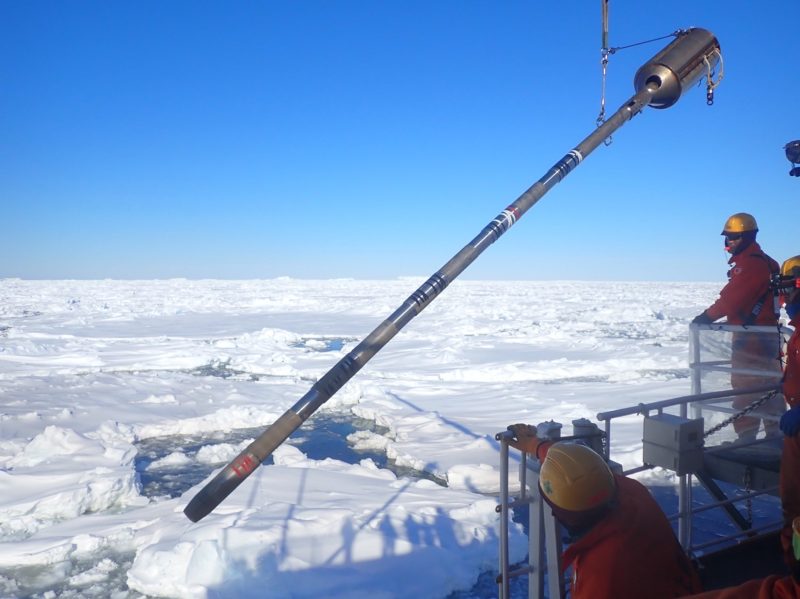
(Photo) A scene from the 61st Japanese Antarctic Research Expedition (2019–2020) showing the collection of seafloor sediment cores from the Antarctic research vessel "Shirase." A large cylindrical device (core sampler) is driven vertically into the seafloor and then retrieved to collect sediment samples.
(Note 1)
In coastal regions of polar areas such as Antarctica and Greenland, glaciers flowing from the mainland reach the sea and form massive sheets of ice up to several hundred meters thick that float on the water. These are called ice shelves.
(Note 2)
In recent years, the concept of a “tipping point”—a point at which changes in climate conditions cross a critical threshold, causing a rapid and irreversible shift to a different state—has garnered significant attention in the context of climate change.On the other hand, a “tipping cascade” refers to a phenomenon in which a climate change event (tipping point) in one region triggers another climate change event (tipping point) in a distant region, causing tipping points to cascade like dominoes and leading to large-scale changes. Specific examples of such phenomena include the weakening of deep ocean circulation and the melting of ice sheets; whether these cascades will actually occur remains a major research topic today.
Published in: Nature Geoscience
Title: Holocene Antarctic ice shelf collapse driven by meltwater release feedbacks
Author:
菅沼 悠介(国立極地研究所 地圏研究グループ 教授/総合研究大学院大学 教授)
Takuya Itagi (Research Group Leader, National Institute of Advanced Industrial Science and Technology)
Yuki Haneda (Researcher, National Institute of Advanced Industrial Science and Technology)
Kazuya Sobara (Associate Researcher, Japan Agency for Marine-Earth Science and Technology)
Takashi Konagaya (Project Researcher, Institute of Atmospheric and Oceanic Research, The University of Tokyo; (currently) Project Researcher, Japan Agency for Marine-Earth Science and Technology)
石輪 健樹(国立極地研究所 地圏研究グループ 助教/総合研究大学院大学 助教)
Takayuki Omori (Special Researcher, University of Tokyo Museum)
池原 実(高知大学海洋コア国際研究所 教授)
Rob McKay (Professor, Victoria University of Wellington)
Sai Seki (Associate Professor, Institute of Low Temperature Science, Hokkaido University)
平野 大輔(国立極地研究所 気水圏研究グループ 助教/総合研究大学院大学 助教)
藤井 昌和(国立極地研究所 地圏研究グループ 助教/総合研究大学院大学 助教)
加藤 悠爾(高知大学海洋コア国際研究所 講師)
Atsuko Amano (Research Group Leader, National Institute of Advanced Industrial Science and Technology)
Yuki Tokuda (Associate Professor, Tottori University of Environmental Studies)
岩谷 北斗(山口大学大学院創成科学研究科 講師)
Katsuaki Suzuki (Principal Researcher, National Institute of Advanced Industrial Science and Technology)
Mikihiro Hirabayashi (Project Assistant Professor, Atmosphere-Hydrosphere Research Group, National Institute of Polar Research)
Hiroyuki Matsuzaki (Professor, University Museum and Archives, The University of Tokyo)
Takeyasu Yamagata (Research Associate, University Museum and Archives, The University of Tokyo)
岩井 雅夫(高知大学海洋コア国際研究所 教授)
Kota Kazuki (Associate Professor, Estuary Research Center, Shimane University)
Francisco J. Jimenez-Espejo (Spanish National Research Council, Researcher)
松井 浩紀(秋田大学大学院国際資源学研究科 助教)
Koji Seike (Affiliated with a Research Group, National Institute of Advanced Industrial Science and Technology)
Motohito Kawamata (Researcher, Cold Region Foundation Engineering Research Group, Cold Region Civil Engineering Research Institute, Public Works Research Institute)
Naohiro Nishida (Associate Professor, Tokyo Gakugei University)
伊藤 優人(国立極地研究所 気水圏研究グループ 特任研究員、
現:東京大学大学院新領域創成科学研究科 特任研究員)
Shin Sugiyama (Professor, Institute of Low Temperature Science / Arctic Research Center, Hokkaido University)
奥野 淳一(国立極地研究所 地圏研究グループ 助教/総合研究大学院大学 助教)
澤柿 教伸(法政大学 社会学部 教授)
Ayako Abe (Professor, Institute of Atmospheric and Oceanic Physics, The University of Tokyo)
Shigeru Aoki (Professor, Institute of Low Temperature Science, Hokkaido University)
Hideki Miura (Professor, Aomori Public University)
DOI: 10.1038/s41561-025-01829-7
Publication Date: November 7, 2025, at 7:00 PM (Japan Standard Time)
本研究はJSPS科研費(JP16H05739、JP17H06321、JP17H06318、JP19H00728、JP21KK0246、JP24H00026、JP24H02344)、国立極地研究所のプロジェクト研究費(KP-7、KP306)、および高知大学海洋コア国際研究所共同研究(No. 20A040、20B037、22A007、22B006)の助成を受けて行われました。また、現地調査・試料採取は日本の南極地域観測隊(第22、33、47、57、59、61、64次隊)によって行われました。