◆海洋コア国際研究所の佐野有司所長らの研究成果が「Nature Communications」誌に掲載されました
Release Date:
Regular monitoring of hot springs and deep groundwater in the northeastern part of the Noto Peninsula has revealed that deep-seated fluids...
The study clarified the origins and the seismic activity preceding the 2024 Noto Peninsula Earthquake
Long-term swarms of earthquakes had been observed in the northeastern part of the Noto Peninsula even before the 2024 Noto Peninsula Earthquake, which occurred on January 1, 2024. A research team comprising members from the University of Toyama, Kochi University, the University of Tokyo, and Kanazawa University has been regularly investigating hot springs and deep groundwater in the northeastern Noto Peninsula since 2022, observing temporal variations in the helium isotope ratio ( ³He/⁴He ratio ) *1. The observed high 3He/4He ratios, combined with seismic tomography*2, suggest that fluids ascending from the mantle were involved in the swarm of earthquakes. Furthermore, the decrease in the 3He/4He ratio prior to the 2024 Noto Peninsula Earthquake is believed to be caused by degassing from rocks in the aquifer that deformed due to changes in strain.
The findings of this study were published in *Nature Communications* on Wednesday, November 26, 2025 (Japan Standard Time).
Press Release: Noto Helium [PDF: 836 KB ]
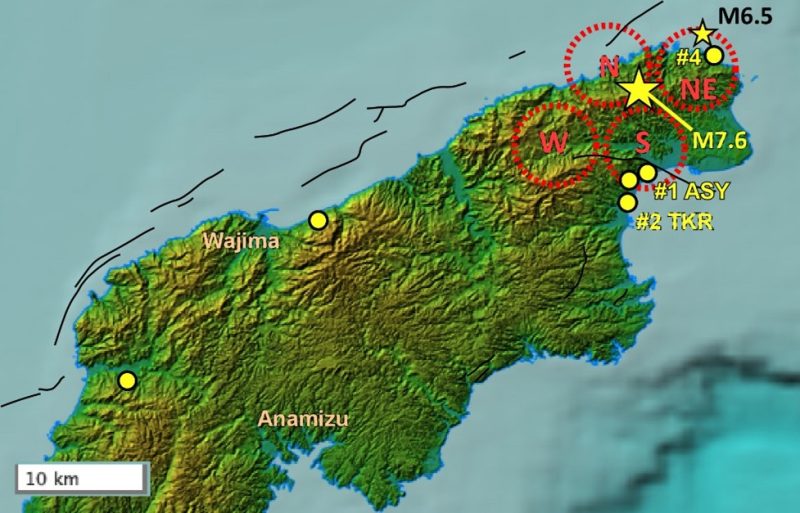
Figure: Survey Locations
Circles indicate the survey locations in this study; the sites where regular observations were conducted—#1 ASY and #2 TKR—are located in the northeastern region. Asterisks indicate the epicenters of the M6.5 earthquake that occurred in May 2023 and the M7.6 earthquake that occurred on January 1, 2024.The areas enclosed by dashed circles indicate the epicenter clusters S, W, N, and NE (Amezawa et al., 2023, Geophys. Res. Lett.; Nishimura et al., 2023, Sci. Rep. ).The black lines represent active faults (Inoue and Okamura (2010), Geological Survey of Japan; Ozaki (2010), Geological Survey of Japan). This figure was created by modifying a basemap generated from the "Geographical Survey Institute Map (Electronic National Land Web)" (Geographical Survey Institute of Japan; https://maps.gsi.go.jp/development/ichiran.html).
*1) 3He/4He ratio
The stable isotope ratios of helium are expressed as follows. Helium has stable isotopes with mass numbers 3 and 4; 3He is primarily a primordial component incorporated into the solid Earth from outer space during the Earth’s formation, while 4He consists of alpha particles produced by the radioactive decay of uranium and thorium.Since the 3He/4He ratio is high in the mantle and low in the crust, measuring the 3He/4He ratio in hot springs and groundwater allows us to analyze the origin of the helium.
*2) Seismic tomography
This method estimates the subsurface seismic velocity structure using seismic arrival time data. Since seismic velocity varies depending on factors such as the density of materials, this method is useful for investigating the subsurface structure.
[Details of the Announcement]
Title: Helium Isotope Anomaly in Groundwater Prior to the 2024 Noto Peninsula Earthquake
Authors: Takanori Kagoshima, Yuji Sano, Naoto Takahata, Yume Kawamoto, Tomo Shibata, Ying Li, Tomoaki Morishita, Yoshihiro Hiramatsu, Junichi Nakajima
Published in: Nature Communications
DOI: 10.1038/s41467-025-65717-9
Release Date: November 26, 2025