◆Research findings by Assistant Professor Takuma Higuchi and Professor Shuichi Sakamoto of the Department of Basic Medical Sciences, Division of Medical Sciences, Faculty of Education and Research, have been published in "FEBS Open Bio," the academic journal of the Federation of European Biochemical Societies (FEBS).
Release Date:
Researchers Discover Regulatory Mechanism of "RNA Modification" That Influences the Production of MicroRNAs Involved in Cancer Development
Research findings by Assistant Professor Takuma Higuchi and Professor Shuichi Sakamoto of the Department of Basic Medical Sciences in the School of Medicine have been published in the academic journal *FEBS Open Bio*, published by the Federation of European Biochemical Societies, with the online version released on December 6, 2025.
MicroRNAs (miRNAs) are functional small non-coding RNAs; since their expression levels fluctuate in various diseases, including cancer, they are expected to be utilized as disease markers and therapeutic targets.In recent years, it has been reported that methylation of the adenine base in miRNA precursor transcripts (pri-miRNAs) leads to the promotion of miRNA biosynthesis. The m6A modification of pri-miRNAs is carried out by the methyltransferase complex METTL3/14.However, many aspects of the regulatory mechanism governing pri-miRNA m6A modification by METTL3/14 remain unclear.
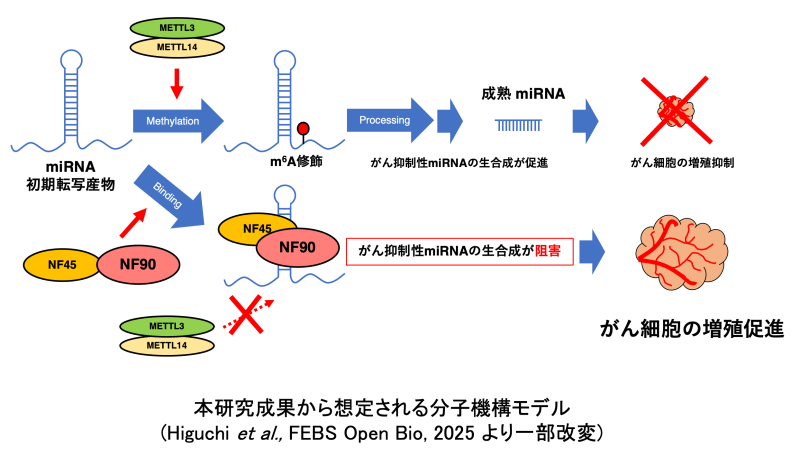
In our research group, we have previously discovered that the complex of Nuclear Factor 90 (NF90), a double-stranded RNA-binding protein, and its binding partner NF45 (NF90–NF45) binds to pri-miRNAs and negatively regulates miRNA biogenesis.In this study, we demonstrated that NF90–NF45 inhibits m6A modification of pri-miRNAs that exhibit high binding affinity for NF90–NF45.
In this study, we focused specifically on the primary transcripts (pri-miR-7-1 and pri-miR-186) of the tumor-suppressor miRNAs “miR-7” and “miR-186,” which exhibit high binding affinity for NF90–NF45, and conducted an analysis.The results demonstrated that pri-mir-7-1 and pri-mir-186 undergo m6A modification by METTL3/14, and that NF90–NF45 significantly inhibits this m6A modification.In contrast, no inhibitory effect of NF90–NF45 on m6A modification was observed for pri-mir-200a, which has low binding affinity for NF90–NF45. Based on these findings, a molecular mechanism model was proposed: “NF90–NF45 binds to pri-miRNAs, thereby blocking METTL3/14 access to pri-miRNAs and consequently inhibiting m6A modification.”
Upregulation of NF90–NF45 has been reported in various cancer types derived from different tissues, and these findings are expected to contribute to elucidating the mechanisms underlying miRNA expression changes associated with cancer development.

<論文情報>
タイトル: Domain associated with zinc fingers-containing NF90-NF45 complex inhibits m6A modification of primary microRNA by suppressing METTL3/14 activity
著者: Takuma Higuchi, Shunsuke Morioka, Keiko Morisawa, Kazutsugu Matsukawa, Shingo Ashida, Takeshi Suzuki, Shuji Sakamoto
掲載誌: FEBS Open Bio
DOI:
The website for the Experimental and Practical Training Facilities / Radioisotope (RI) Experimental Facilities of the Department of Life Function Analysis, Kochi University Center for Integrated Research, is
The website for the Experimental and Training Equipment Facility [Department of Molecular Biology] of the Division of Life Function Analysis, Kochi University Comprehensive Research Center is here