◆Research findings by a group led by Professor Yuji Yamamoto of Marine Core Research Institute(MaCRI) have been published in the *Journal of Cultural Heritage*
Release Date:
3D Reconstruction of a Post Town Submerged at the Bottom of a Lake Using Geoscientific Methods
—Science Brings Back to Life “Hibara-juku,” Submerged by the 1888 Mount Bandai Eruption—
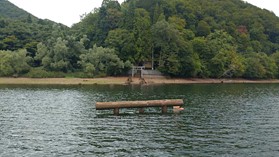
Professor Yuji Yamamoto of Marine Core Research Institute(MaCRI) and the Japan Agency for Marine-Earth Science and Technology (JAMSTEC; President: Hiroyuki Yamato)and a research team led by Researcher Wataru Tanigawa of the Kochi Core Research Institute have successfully reconstructed the submerged townscape in three dimensions by conducting detailed measurements of the lake-bottom topography of the former Hinohara-juku site—a natural disaster site submerged in Lake Hinohara in Kitashiobara Village, Yama District, Fukushima Prefecture (a post town on the Aizu-Yonezawa Highway)—using a high-resolution multibeam echo sounder.This study is the first instance in which the structure of a town remaining on the lake bottom of Lake Hibara—formed by the 1888 eruption of Mount Bandai—has been revealed using non-destructive geoscientific methods.
This research was supported by JSPS KAKENHI Grant 22H00028 and a collaborative research grant from the Disaster Prevention Research Institute, Kyoto University (2021K-07).
The research findings were published in the Journal of Cultural Heritage (Elsevier) in December 2025.
Title: Reconstructing a Submerged Post Town in Japan: Microtopographic Analysis of Hibara Village Beneath Lake Hibara
Authors: Wataru Tanigawa1,2, Shintaro Yamasaki3, Tetsuya Yamamoto1, Atsushi Kimura4, Masao Yoshida5, Eiji Nakagawa6, Akihiro Shimada7, Yuji Yamamoto2, Rantei Sasaki8, Takehiro Hirose1
1. R&D DepartmentMarine Core Research Institute(MaCRI)R&D Department; 2. Marine Core Research Institute(MaCRI); 3. Kyoto University Disaster Prevention Research Institute; 4. Faculty; 5. Kitashiobara Village Board of Education; 6. Toyohashi City Museum of Art; 7.Izukunishi City, 8. Teikyo University Institute for Cultural Heritage