Weakening of the North Atlantic Ocean Circulation Drives Ice Sheet Fluctuations in the Distant Southern Hemisphere—Geological Samples and Numerical Simulations Uncover a Global Climate Change Chain Reaction—
Release Date:
Japan Agency for Marine-Earth Science and Technology (JAMSTEC)
Kyushu University
The University of Tokyo
Kochi University
Hokkaido University
Faculty of Science and TechnologyProfessor Seishun Hasegawa; Takuto Kasuya, Researcher at the Center for Earth Surface System Research, Division of Global Environmental Research, Japan Agency for Marine-Earth Science and Technology (JAMSTEC; President: Tomohiko Kawamura) (at the start of the research: Research Student at JAMSTEC / Doctoral Candidate in Earth and Planetary Sciences, Graduate School of Science, Kyushu University Graduate School );Yuta Kuniyoshi Graduate School( Doctoral Course) of the Atmosphere and Ocean Research Institute, The University of Tokyo (at the time of the research; currently a Research Fellow at the National Institute for Environmental Studies), and others, conducted a paleoclimatology (*1) study combining the geological record with numerical models and revealed that the weakening of the Atlantic Meridional Overturning Circulation (*2; hereinafter AMOC) can have a significant impact on the climate of distant mid- and high-latitude regions in the Southern Hemisphere.
Key Points of the Presentation
- Amid concerns about the future weakening of the Atlantic Meridional Overturning Circulation (AMOC)—a critical ocean circulation system deeply involved in the Earth’s climate—and growing interest in how its effects might ripple across the globe, this study focused on past episodes of large-scale weakening and investigated their impacts on the climate of the distant Southern Hemisphere and the Patagonian ice sheet in South America using the geological record and numerical simulations.
- An analysis of Late Glacial (*3) strata from the deep seafloor off the coast of Chile in the southeastern Pacific revealed that the supply of particles from land repeatedly increased in response to the weakening of the AMOC. The study suggested that this may have been driven by climate and ice sheet fluctuations in which snowfall increased in the interior of the Patagonian Ice Sheet, while meltwater runoff became more active in its peripheral regions.
- These results suggest that the weakening of the AMOC may have caused rising sea surface temperatures and a strengthening of the westerlies in the mid- and high-latitude regions of the Southern Hemisphere, including Patagonia, along with an associated increase in precipitation. These findings provide a scientific foundation for understanding the “climate change cascade” that can occur on a global scale as a result of changes in the AMOC and for making more accurate future projections.
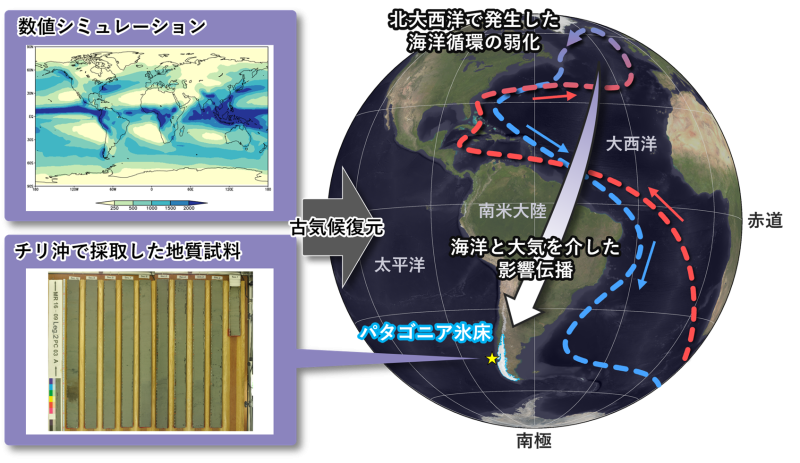
Figure: Reconstruction of past global climate change sequences using geological samples and numerical simulations
(Satellite image: https://science.nasa.gov/earth/earth-observatory/the-blue-marble-true-color-global-imagery-at-1km-resolution/ )
*1 Paleoclimatology: An academic field that aims to reconstruct past climate environments and elucidate the mechanisms behind their fluctuations. Its methodologies are primarily divided into proxy research—which analyzes geological samples using surrogate indicators of climate and environment—and model research—which performs simulations using numerical models that reproduce the atmosphere, oceans, and land surfaces.
*2 Atlantic Meridional Overturning Circulation (AMOC): A large-scale ocean circulation system consisting of a warm current flowing northward along the surface of the Atlantic Ocean (red arrow in Figure 1) and a cold current that turns around in the North Atlantic and flows southward in the deep ocean (blue arrow in Figure 1).It contributes to heat transfer between low and high latitudes and plays a role in regulating the Earth’s climate.
*3* Last Glacial Period: Over the past 800,000 years, Earth’s climate has alternated between cold glacial periods and warm interglacial periods in 100,000-year cycles. The Last Glacial Period was the most recent glacial period, lasting from approximately 115,000 years ago to 12,000 years ago.
Paper Information
Title: Patagonian Ice Sheet discharge enhanced by AMOC slowdown through thermal bipolar seesaw
Authors: Takuto Kasuya1,2, Yuta Kuniyoshi3, Kana Nagashima1, Sei Hasegawa4, Ayako Abe3, Julia R. Hagemann5,6, Helge W. Arz7, Carina B. Lange8,9,10, Frank Lamy6, Shinya Iwasaki11, Wing-Le Chan3, Naomi Harada1,3, Masafumi Murayama4, Fuyuki Saito1, Hironori Okazaki2
1. Japan Agency for Marine-Earth Science and Technology (JAMSTEC), 2. Kyushu University,3. Institute of Atmospheric and Oceanic Research, The University of Tokyo; 4. Kochi University; 5. Rutgers University; 6. Alfred Wegener Institute for Polar and Marine Research; 7. Leibniz Institute for Baltic Sea Research; 8. University of Concepción; 9. Austral University; 10. Scripps Institution of Oceanography; 11. Hokkaido University
DOI: