Research findings by Professor Makoto Ashinai and colleagues from the Department of Life, Environmental, and Medical Sciences in the School of Integrated Sciences have been published in the *Journal of Coatings Technology and Research*.
Release Date:
―Rapid Formulation of "Poly-γ-Glutamic Acid" from Natto Slime
—Application as a Safer, Versatile Antimicrobial Coating Agent—
Research findings by Professor Makoto Ashinai and colleagues from the Department of Life, Environmental, and Medical Sciences in the School of Integrated Sciences have been published online in the *Journal of Coatings Technology and Research*.
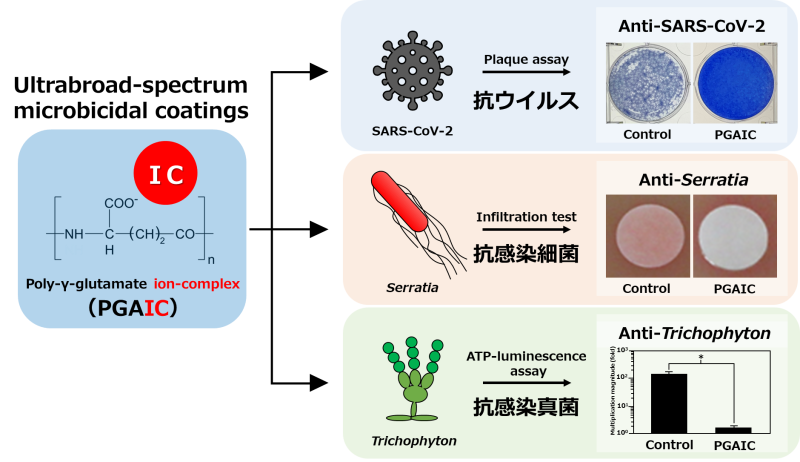
Since the COVID-19 pandemic, there has been a growing need to establish preventive public health technologies. This is an especially urgent issue in Japan, which is facing a declining and aging population. In the field of preventive public health, the challenge lies in the cross-cutting and sustained inactivation of pathogens of various origins, including viruses, bacteria, and fungi.Professor Ashina and his team have successfully developed and produced a new material, “Poly-γ-Glutamic Acid Ion Complex (PGAIIC),” which possesses broad-spectrum (universal) antimicrobial properties, derived from “poly-γ-glutamic acid (PGA),” a component of natto slime, and “cetylpyridinium (CPC),” a food additive listed on the positive list.An antimicrobial surface treatment method utilizing the excellent coating properties of PGIC has also been devised.
Specifically, the following results were disclosed.
① On plastic treated with PGAIC coating, the logarithmic reduction factor for COVID-19 replication reached 3.80, achieving 99.99% inactivation, while the virus removal efficiency of glass fiber was also improved.
② Analysis of the penetration of Serratia bacteria (a type of nosocomial opportunistic pathogen) into polyether sulfone and paper filtration filters demonstrated that the PGAIC coating was highly effective in preventing penetration (and proliferation).
③ PGAIC coating is also effective in inactivating dermatophyte spores; it achieved a log reduction of 2.11, eliminating 99.2% of germination capacity.
④ We calculated the log reduction values for fungi and other microorganisms that can cause pneumonia (sooty mold: 2.44; black mold: 2.39; airborne mold: 2.64; blue mold: 2.88).
⑤ It was suggested that the broad-spectrum antimicrobial activity in this study depends on a trapping mechanism (a kinetically slow and sustained bactericidal mechanism).
⑥ He discussed the social value of "PGAIIC-coated corrugated cardboard" materials, which provide hygiene management equivalent to handwashing.
This paper has been recognized for providing fundamental insights into the current status and future potential of "PGAIIC," a novel material driven by capture and sterilization.

(Adapted from Onari and Ashiuchi, J. Coat. Technol. Res. 2026)
Part of this research was conducted with support from the JST “Bridge Program from Goal-Oriented Basic Research to Commercialization (A-STEP)” (Grant No. JPMJTM20S0) and the “Next-Generation Researchers’ Challenging Research Program (SPRING)” (Grant No. JPMJSP2162).Furthermore, the production of the PGIC coating and the broad-spectrum antimicrobial testing were conducted with technical support from Toyo Filter Paper Co., Ltd.
[Paper Information]
Paper Title: Rapid Formulation and Application of Poly-γ-Glutamate in an Ultrabroad-Spectrum, Safer Microbicidal Coating
Authors: Toma Onari and Makoto Ashiuchi
Journal Title: Journal of Coatings Technology and Research URL: http://doi.org/10.1007/s11998-025-01239-9