Core Research Project (FY2022–)
We introduce research projects that leverage our university's strengths in marine, life, and field sciences to advance societal implementation (value creation). These projects aim to solve regional challenges and utilize local resources through world-class research capabilities.
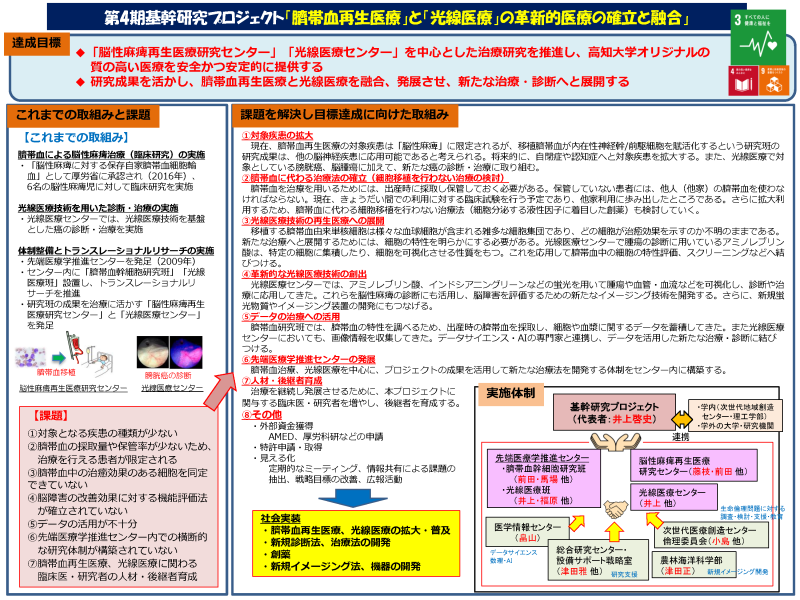
Establishing and Integrating Innovative Medical Treatments: "Umbilical Cord Blood Regenerative Medicine" and "Light Therapy"
Applicant Representative
医学部光線医療センター 教授 井上 啓史
Research Overview
To improve and further advance the “treatment of cerebral palsy using umbilical cord blood” and “phototherapy” currently being conducted at Kochi University—primarily through the “Cerebral Palsy Regenerative Medicine Research Center” and the “Phototherapy Center”—it is essential for basic and clinical researchers to collaborate closely on these studies.In this project, researchers in umbilical cord blood regenerative medicine and phototherapy will collaborate with experts in imaging, data science, and bioethics to expand the range of target diseases, establish alternative treatments to umbilical cord blood transplantation, apply phototherapy technologies to regenerative medicine, and create innovative phototherapy technologies. We aim to translate these achievements into the development of new diagnostic and therapeutic methods, drug discovery, and the creation of novel imaging methods and devices.
Reference Materials
Homepage
Currently in progress
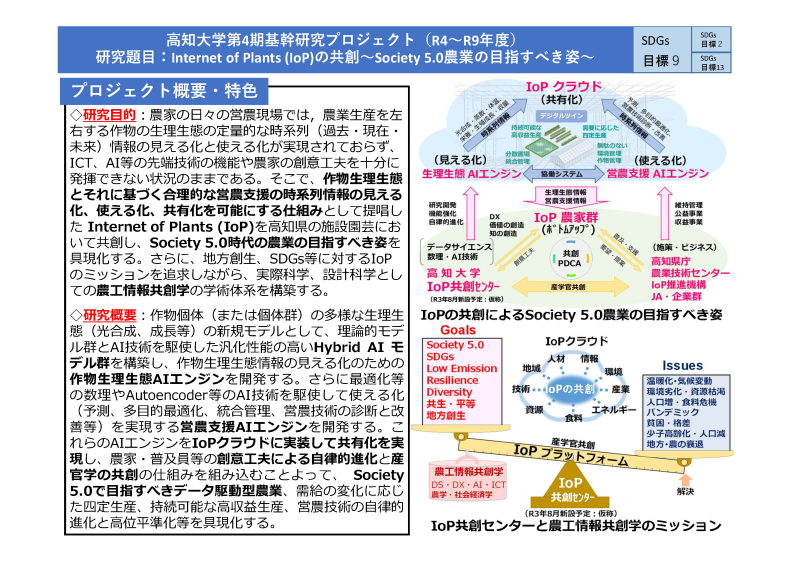
Co-creation of the Internet of Plants (IoP): The Vision for Society 5.0 Agriculture
Applicant Representative
Masaharu Kitano, Specially Appointed Professor, IoP Business Promotion Office
Research Overview
We have proposed the Internet of Plants (IoP) as a mechanism to visualize, make usable, and share physiological and ecological information on crop communities—data that is difficult to measure directly in the field—along with the rational farming support information derived from it. To this end, we will construct a set of hybrid AI models with high generalization performance for the diverse physiological and ecological characteristics of crop communities (such as photosynthesis and growth) and develop a crop physiological and ecological AI engine for visualization.Furthermore, we will develop an agricultural support AI engine that utilizes optimization mathematics and AI technologies such as autoencoders to enable practical applications (e.g., prediction, multi-objective optimization, and diagnosis and improvement of farming techniques).By implementing these AI engines on Kochi Prefecture’s IoP cloud to enable sharing, and by incorporating mechanisms for autonomous evolution driven by the ingenuity of farmers and extension agents, as well as co-creation among industry, government, and academia into the IoP, we will realize the data-driven agriculture and “Four Constants” production aimed for in Society 5.0.Furthermore, while pursuing the IoP’s mission regarding regional revitalization and the SDGs, we will establish an academic framework for Agricultural-Industrial Information Co-creation Science as a practical and design science.
Reference Materials
Homepage
Currently in progress
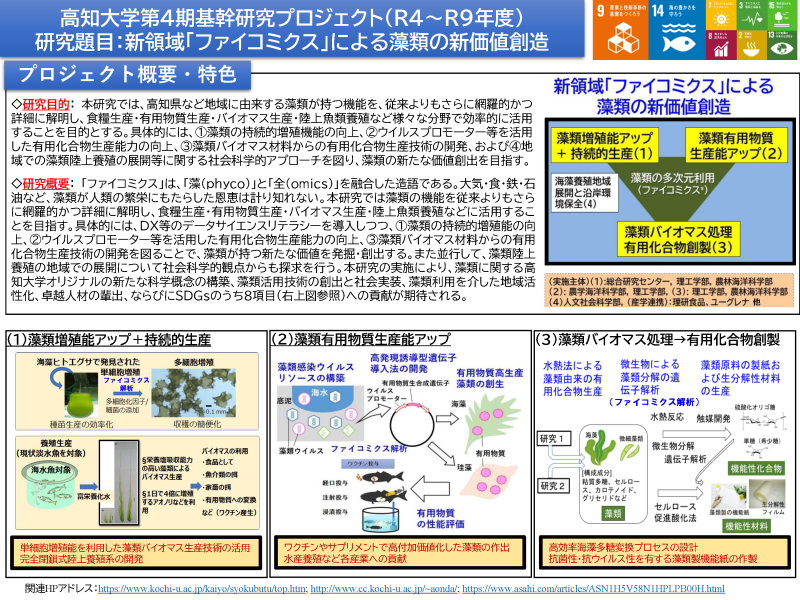
Creating New Value from Algae Through the Emerging Field of "Phycomics"
Applicant Representative
自然科学系理工学部門 教授 長崎 慶三
Research Overview
"Phycomics" is a portmanteau combining "phyco" (algae) and "omics" (comprehensive analysis). This research aims to elucidate the functions of algae in a more comprehensive and detailed manner than ever before, with the goal of applying these findings to food production, the production of useful substances, biomass production, and the aquaculture of freshwater fish.While incorporating data science literacy, including digital transformation (DX), we will explore new value in algae by: (1) improving their sustainable growth potential; (2) enhancing their capacity to produce useful compounds using viral promoters and other methods; and (3) developing technologies to produce useful compounds from algal biomass materials.Furthermore, we will explore the regional implementation of terrestrial algal aquaculture from a sociological perspective. This research is expected to lead to the establishment of Kochi University’s original scientific concepts regarding algae, the creation and societal implementation of algal utilization technologies, regional revitalization through algal utilization, the cultivation of outstanding talent, and contributions to eight of the SDGs.
Reference Materials
Homepage
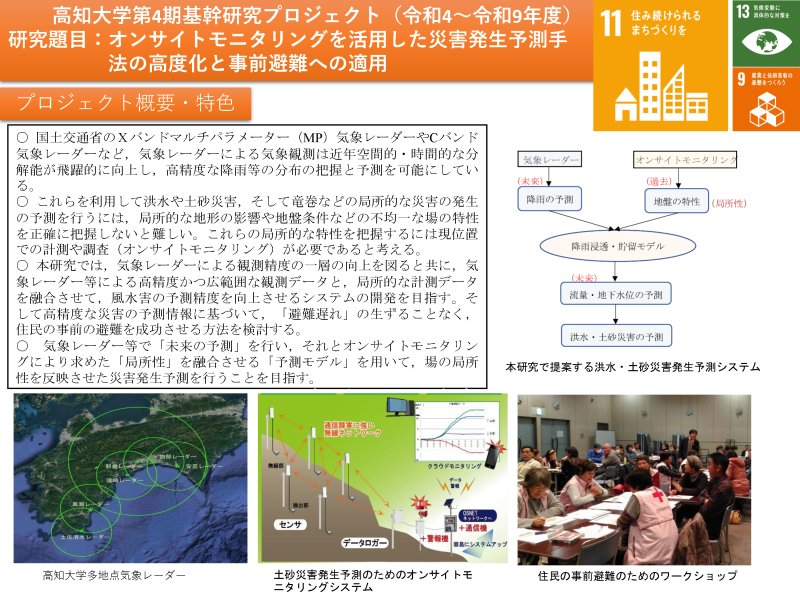
Improving Disaster Prediction Methods Using On-Site Monitoring and Their Application to Preemptive Evacuation
Applicant Representative
防災推進センター 教授 笹原 克夫
Research Overview
This project aims to further improve the accuracy of meteorological radar observations while developing a system that integrates high-precision, wide-area observational data from meteorological radars and other sources with local measurement data (on-site monitoring) to enhance the accuracy of flood and wind disaster predictions. Based on this, we will explore methods to ensure the successful, timely evacuation of residents, thereby preventing delays in evacuation. In recent years, the spatial and temporal resolution of observations from the Ministry of Land, Infrastructure, Transport and Tourism’s weather radars has improved dramatically, enabling highly accurate forecasts of precipitation and other phenomena. However, to predict the occurrence of localized disasters such as floods, landslides, and tornadoes, it is necessary to consider the characteristics of heterogeneous environments, including the influence of local topography and ground conditions.For example, in the case of "flooding," unless the local rainfall infiltration characteristics of the ground are understood, it is impossible to determine how much of the rainfall will run off without infiltrating the ground; therefore, it is necessary to combine observational data with local measurement data.
Reference Materials
Homepage
Currently in progress
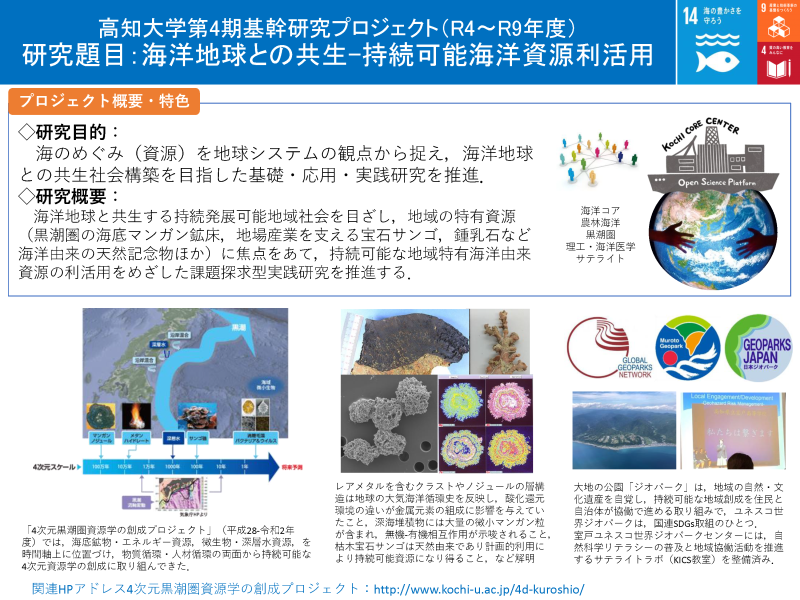
Coexistence with the Ocean and Earth: Sustainable Utilization of Marine Resources
Applicant Representative
海洋コア総合研究センター 特任教授 佐野 有司
Research Overview
We will promote practical research focused on the region’s unique marine resources—such as seafloor manganese deposits in the Kuroshio Current region, gem-quality coral that supports local industries, and marine-derived natural monuments like stalactites—with the aim of achieving the sustainable utilization and societal implementation of these resources.
We aim to build sustainable local communities that coexist with the marine environment and Earth, and we are advancing research on the region’s unique potential resources. Specifically, we are conducting research on Earth system environmental dynamics during the Anthropocene and Pre-Anthropocene periods; developing Project-Based Learning (PBL) programs using Geoparks and the Kuroshio region as field sites for social implementation; and conducting practical research on the dissemination of these programs and the development of human resources.
Reference Materials
Homepage
Currently in progress