Revision of Indirect Costs in Joint Research Projects
Thank you for your continued support of our university’s educational and research activities.
Please be advised that, with the aim of strengthening industry-academia-government collaboration and joint research, the university has decided to revise the indirect cost rate for joint research projects effective October 1, 2026. Details are provided below.
Reasons for the Revision
Regarding indirect costs associated with the University’s collaborative research projects, the previous revision (in 2020) set these costs at 20% of direct costs, with the exception of large-scale organization-to-organization collaborative research projects, for which they were set at 30% of direct costs. At that time, taking into account the recent severe economic conditions and economic trends, we announced on our website that, as an interim measure, the rate would be set at 20% as a temporary measure.
In the six years since the revision, social conditions have undergone significant changes, including the expansion of GDP and corporate research investment*¹, rising prices*², and the need to maintain the research environment, as well as the increase in research support costs such as the University’s intellectual property-related expenses*³. To ensure the smooth and continuous advancement of the University’s collaborative research, it has become essential for the University to maintain and further develop an appropriate research and development environment and research support system.
Furthermore, looking at universities nationwide, 73 out of 86 national university corporations and inter-university research institutes*⁴ have adopted an indirect cost rate equivalent to 30% of direct costs; thus, our university’s current rate of 20% is low even by national standards.
In light of these circumstances, indirect costs to 30% of direct costs (the same rate as the current standard for large-scale inter-organizational collaborative research) , .
We kindly ask for your understanding and cooperation.
Revisions
Revision of the Indirect Cost Rate
Before revision: 20% of direct costs
For large-scale collaborative research between organizations: 30% of direct costs
↓
After revision: 30% of direct costs (flat rate)
Start Date
Joint research projects commencing on or after October 1, 2026
When changing expenses related to joint research projects on or after October 1, 2026
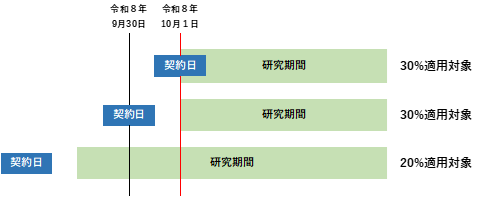
*However, if you wish to begin by September 30, 2026, please submit the Joint Research Application Form to the relevant department by Monday, August 31, 2026.
Please note that if we do not receive your submission, your contract may be postponed until October or later.
Main Uses of Indirect Costs in Collaborative Research
*Note: This is separate from the use of funds from donations or indirect costs from research grants.

*Kochi University Innovation & Social Impact Initiative (i³K)
The Kochi University Innovation & Social Impact Initiative (i³K [i-cube-k] ) aims to generate world-leading science and technology based on the university’s distinctive research, while also establishing a “regional innovation co-creation hub” where industry, academia, government, and the public sector collaborate to build a prosperous future society.(Established April 1, 2016)
To achieve this objective, i³K—as an organization tasked with advancing the research and development strategy formulated by the University’s Management Planning Office—will establish a seamless research support system that provides comprehensive, end-to-end support, from basic research through to industry-academia-government collaboration leading to societal implementation. Through this, we will advance the deepening of basic research and the societal implementation of research outcomes more proactively and strategically than ever before.
For your reference
※¹■ (Nationwide) Trends in Real GDP (Source: National Institute of Economic and Social Research, Cabinet Office)
FY2020: 554.3 trillion yen, FY2024: 586.9 trillion yen
■ (Nationwide) Increase in Total Corporate Expenditures on Science and Technology Research(Source: Ministry of Internal Affairs and Communications Science and Technology Research Survey)
FY2020 Actual: 13.8608 trillion yen FY2024 Actual: 17.4303 trillion yen
※²■Trends in the Consumer Price Index (All Items) as of 2020 (Source: Statistics Bureau, Ministry of Internal Affairs and Communications)
With 2020 set at 100, the index stood at 113.0 as of December 2025
※³■Increase in intellectual property-related expenses at this university
Increase in patent application expenses and outsourcing fees for Shikoku TLO, etc.
| R2 | R3 | R4 | R5 | R6 |
| 17,601 | 28,915 | 27,060 | 27,100 | 21,495 |
Center for Regional Sustainability and Innovation(CeRSI)Regional Innovation Section Property Division Materials
※⁴■Status of Indirect Cost Rates at 86 National University Corporations and Inter-University Research Institutes
Percentage of indirect costs in joint research with private companies and other entities (Cited from the minutes of the 2023 Meeting of Directors of Research Capability Divisions)

Other Reference Information
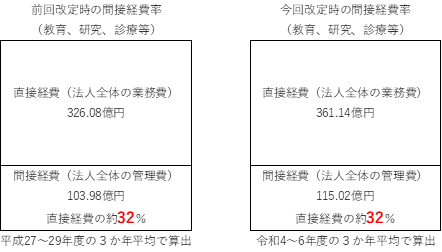
■Proportion of Administrative Expenses in the University’s Operating Budget
Status of expenses required to carry out the corporation’s overall activities (remaining stable at approximately 32% since the previous revision)
■Number of Collaborative Research Projects Accepted by the University (from the Private Sector, Local Governments, Public Institutions, etc.) and Total Funding Received

(Situation in Kochi Prefecture)
■ Report on Regional Accounts (Source: Fiscal Year 2022)
| Survey Data for 2020 | Survey Data for 2022 | |
| Gross Regional Product (nominal) | 2.3277 trillion yen | 2.4074 trillion yen |
| Economic growth rate (nominal) | -4.8% | 1.2% |
| Per capita prefectural income | 2,475,000 yen | 2,703,000 yen |
| Corporate income | 455.4 billion yen | 564.1 billion yen |