Medical School
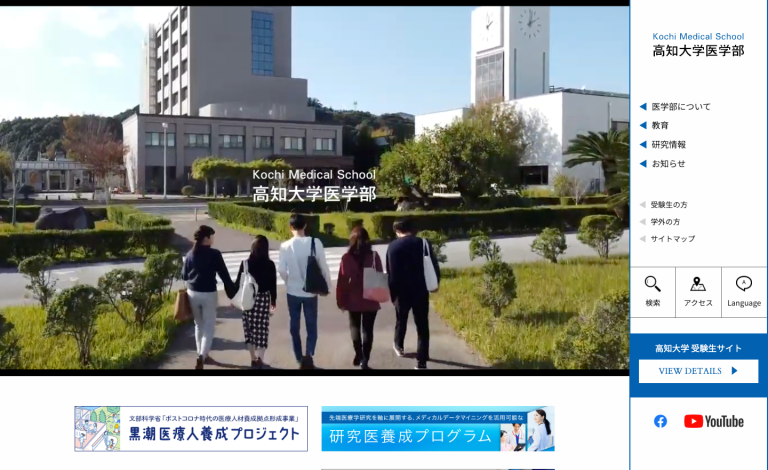
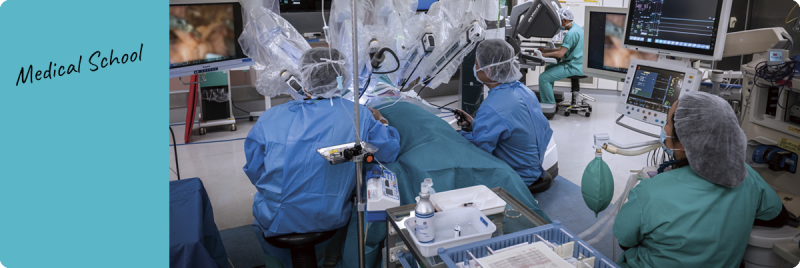
We cultivate physicians and nurses with high ethical standards and a strong sense of mission, who excel in both cutting-edge and community-based healthcare, thereby contributing to regional healthcare in Kochi Prefecture.
-800x267.jpg)
Contributing to regional healthcare in Kochi Prefecture
The dramatic advancements in medicine and healthcare as a science in recent years continue to have a profound impact on society as a whole. To respond to these changes, individuals working in the medical and healthcare fields must establish their own ethical frameworks. The foundation of this lies in multifaceted analytical and problem-solving abilities, supported by robust ethical judgment and a sense of balance cultivated over many years. The School of Medicine aims to identify individuals from a wide range of backgrounds who possess these abilities, a strong motivation for pursuing medicine and healthcare, and the necessary aptitude. We strive to nurture healthcare professionals who possess the high ethical standards, sense of mission, and flexibility of thought required to meet the diverse social needs of this century, as well as a strong desire to contribute to regional healthcare in Kochi Prefecture.
Message from the Dean of the School of Medicine
Kochi University School of Medicine: A place of learning where both students and faculty can share in the excitement
I am Keiji Inoue. I was appointed Dean of the Faculty of Medicine in 2024 and have been working to manage the faculty under the slogan: “Kochi University Faculty of Medicine: A place of learning where students, faculty, staff, and the local community can all share a sense of excitement.” I have been given the opportunity to continue serving as Dean for another two years, starting in April 2026.Moving forward, guided by the founding principles of Kochi Medical University—“Respect for Heaven and Love for Humanity” and “The Pursuit of Truth”—I am committed to fulfilling the School of Medicine’s mission of nurturing compassionate doctors, nurses, educators, and researchers who meet the needs of the local community. To this end, I intend to maintain close communication with faculty, staff, and students, fostering an open school administration where we think and act together, and to dedicate myself to the overall development of Kochi University.
In 2022, the seven-year large-scale initiative “Kuroshio Medical Professional Training Project,” led by the former Dean of the Faculty of Medicine, was selected by the Ministry of Education, Culture, Sports, Science and Technology as a hub for training medical personnel in the post-COVID era. Kochi University,and Mie University—which share common challenges such as population decline, high aging rates, regional disparities in medical care, and the risk of a massive Nankai Trough earthquake—have collaborated on this educational initiative for medical students. The goal is to train a new generation of “Kuroshio Medical Professionals” equipped with comprehensive skills to meet regional needs. By partnering with hub hospitals in areas facing physician shortages, we have implemented practical learning starting in the early years of medical school. Through the joint development of e-learning content, the hosting of joint symposia, and mutual exchanges between students and faculty, we have strived to create diverse learning opportunities and improve educational quality.
Following this, in 2024, a six-year large-scale project titled “Training Program for Research Physicians Capable of Utilizing Medical Data Mining, Centered on Advanced Medical Research” was selected as part of the Ministry of Education, Culture, Sports, Science and Technology’s Initiative for Establishing Centers for Training Advanced Medical Personnel.We were able to launch an educational initiative to train “Advanced Medical Fellows” who can promote Kochi University School of Medicine’s distinctive cutting-edge medical research—such as photomedicine, regenerative medicine, and genomics—as well as medical data mining research utilizing the new RYOMA3 system, while also learning research support at the Center for Next-Generation Medical Innovation and practicing high-quality clinical guidance.
In addition to these proactive initiatives to nurture undergraduate students and young physicians, we have worked to improve the pass rate for the National Medical Licensing Examination, increase enrollment and completion rates for graduate programs, and address challenges identified in the field-specific evaluation of medical education. Furthermore, to foster interest in pursuing a career in medicine at an earlier stage, we held our first-ever open campus event targeting not only high school students but also elementary school students.We have also actively and concretely advanced new initiatives with a clear vision for the near future, such as launching a “Hometown Tax” program to deepen our partnership with Nankoku City, where our campus is located.
Moving forward, the Faculty of Medicine at Kochi University will continue to promote cutting-edge medical education centered on the two major themes demanded by society—advanced medicine and community healthcare. We will cultivate doctors, nurses, medical educators, and medical researchers who embody the “Kochi brand” and who will pioneer and lead the next generation of medicine and nursing, sending them out from Kochi to the world. Finally, the Kochi University School of Medicine welcomed its first class of students from Kochi Medical University in April 1978, and in 2028, we will celebrate the 50th anniversary of the founding of the Kochi University School of Medicine (formerly Kochi Medical University).We would like to express our heartfelt gratitude to our graduates, their families, all those involved, and the local community for their support over the past 50 years. Looking ahead to the next 50 years, we are committed to strengthening our efforts to train the next generation of healthcare professionals who will firmly support the future of the Kochi University School of Medicine, and we will strive to achieve even greater progress for both the School of Medicine and Kochi University as a whole. We ask for your continued support and assistance in the future.
Dean of the School of Medicine Keishi Inoue

Message from the Chair of the Department of Medicine
A Message to Those Aspiring to Become Doctors
The medical program is a course of study with the clear objective of obtaining a national medical license. To achieve this, students must possess a certain level of knowledge and experience and must meet a vast number of learning objectives. Among the most important qualities required of a physician is the ability to learn. While the primary task of students is to master the existing body of medical knowledge developed by their predecessors and reach the starting line, the medicine you are learning is, in fact, not perfect but still evolving.The time I have spent as a physician is but a fleeting moment in the vast history of medicine, yet even during that time, medical conventions have frequently been overturned and the field has undergone significant changes.Medicine is constantly evolving, and physicians must engage in lifelong learning. Improving not only your knowledge but also your learning skills will be an asset for life. Learning skills require human abilities that AI cannot replicate—such as grasping concepts and key points, explaining things logically, determining priorities and tackling the most important tasks first, and, in some cases, working cooperatively in groups to both teach and be taught. The only way to acquire these skills is through daily effort. I hope you will approach your studies with a clear sense of purpose and perseverance.
As I mentioned earlier, medicine is constantly evolving, and the driving force behind this evolution is medicine as a science. Before you begin studying clinical medicine, you will first learn about basic medical science and social medicine—the fields that have underpinned the advancement of medicine. I want you to understand that modern medicine is built upon the discoveries of scientists who have challenged conventional wisdom.When studying clinical medicine, linking it to these fields of basic and social medicine will enable a deeper understanding. It is also important to recognize the extent to which current clinical medicine has been scientifically elucidated and which areas remain unexplained.
As you advance to your upper-level years, you will finally begin clinical rotations at hospitals. It is important to remember that a hospital is a public setting where patients come to receive treatment. Therefore, as long as you are conducting clinical rotations there, it is essential to maintain the proper professional demeanor expected of a member of society. Patients are cooperating with you so that you can become doctors, so please conduct yourself with a sense of gratitude.When studying actual clinical cases, your learning efficiency will improve if you approach them while reviewing the concepts you have acquired in clinical medicine. Furthermore, real-world clinical cases are complex systems where various medical conditions interact with one another, and where a patient’s social background and values influence treatment—they rarely follow textbook scenarios exactly.For the most part, it is only through hands-on training that you can truly grasp examination techniques, diagnostic and surgical procedures, and the use of medical equipment and devices. Furthermore, it is important to recognize that a hospital functions not solely through the efforts of physicians, but through collaboration with various professionals across different departments. Hospitals are filled with resources to help you become a doctor; by adopting a mindset of actively seeking experience rather than merely observing, the depth and value of your clinical training will be entirely different.
The fundamental principle that physicians treat patients with respect has remained unchanged since ancient times, but medicine and healthcare have constantly evolved in response to the circumstances of each era. Physicians must also be sensitive to societal trends and changes. I believe that today’s society has changed significantly since my student days. These changes include the accelerating aging of the population, declining birth rates, and population decline in developed nations; the impact of the pandemic; the rapid advancement of IT technology; climate change; and the deterioration of the international situation.Under these circumstances, medicine and healthcare are expected to be significantly affected, and we anticipate that various new challenges will arise, requiring us to respond. To solve these problems, it is essential that you—with your fresh perspectives and flexible thinking—grow as future physicians and play active roles in the fields of clinical practice, research, and education. Above all, the foundational knowledge you acquire in the School of Medicine is crucial for your future success. I sincerely hope that your time as students will be fulfilling.
Dean of the School of Medicine Shinpei Fujimoto

Message from the Chair of the Nursing Department
Since its establishment in 1998, the Department of Nursing at Kochi University’s Faculty of Medicine has produced numerous nursing professionals for clinical, community, and educational settings over the past quarter-century.The Department of Nursing is committed to training "nursing professionals who, grounded in a liberal arts education and specialized knowledge, possess the sensitivity to empathize with people and a strong sense of social justice, and who can support people’s health and daily lives through their nursing practice." Additionally, the department aims to cultivate "individuals equipped with the innovative capacity to realize better healthcare and nursing by continuously learning to address various societal issues from a nursing perspective and working collaboratively with other professions to resolve these challenges."
The general education curriculum is designed to foster a deep understanding of “people” and “learning” itself, providing students with a solid foundation for future specialization. In the specialized courses, we offer an educational program that bridges nursing theory and fundamentals with practical application, enabling students to master nursing science—often referred to as the “science of practice.”The curriculum is comprehensive, incorporating lectures not only from faculty members in the Department of Nursing but also from faculty in the Department of Medicine, as well as from physicians engaged in cutting-edge medical care at the university hospital and highly specialized nurses.
The university hospital is located on the same campus, providing students with opportunities to experience clinical settings from their early years. Through collaboration between the academic department and the clinical setting, we deliver a dynamic educational program grounded in the latest medical and nursing research. Above all, many graduates of the Nursing Department are employed in the Nursing Division of the university hospital, where they warmly support and mentor current nursing students.
In the local community, students participate in clinical rotations in mountainous and rural areas as well as in home-based medical and nursing settings. Additionally, through the “Family Medicine Dojo” run by the Department of Family Medicine, students interact with local residents, patients, and healthcare professionals who support community healthcare, allowing them to learn practical community medicine alongside their fellow medical students.
The Department of Nursing aims to cultivate nursing professionals who possess not only the specialized knowledge required for nursing, but also the ability to adapt flexibly to and overcome the changes and challenges of a rapidly evolving society and healthcare landscape, and to move forward into the future.
Kuniko Tada, Chair of the Department of Nursing

Graduate School (Master's Program), Department of Medical Science
Purpose
Modern medicine has evolved by bringing together the achievements of the natural sciences, including biology, physics, chemistry, and engineering. Furthermore, in the present day, medicine is advancing at a remarkable pace based on the achievements of the life sciences—such as genomics, molecular biology, and developmental biology (development, differentiation, and regeneration)—and is shaping today’s cutting-edge medical practices, including gene therapy, regenerative medicine, and reproductive medicine.On the other hand, the social environment surrounding medicine and healthcare is undergoing significant transformation. This includes the need to reconcile advances in cutting-edge medicine—such as brain death, organ transplantation, in vitro fertilization, and gene therapy—with bioethics; changes in the structure of diseases due to the arrival of a super-aging society; and an increased emphasis on patients’ quality of life (QOL).To respond effectively to this rapidly evolving field of medicine and healthcare, it is desirable to develop and enhance medical science (Medical Science) that aims to harmonize the natural sciences, the humanities centered on the human subject, and medicine.This will enable the cultivation of experts capable of comprehensively addressing the increasingly complex social issues in healthcare and welfare. Therefore, an educational and research system is needed to guide graduates from faculties other than the Faculty of Medicine (including not only natural science faculties such as Science, Agriculture, Pharmacy, and Engineering, but also humanities faculties such as Psychology, Sociology, Economics, and Education) toward medical science.
Through systematic and intensive education covering a broad range of medical science knowledge, this Medical Science Program aims to train researchers and educators in the field of medical science who possess highly specialized knowledge and skills, and to cultivate professionals capable of comprehensively addressing various social issues based on medical science.
Graduate School (Master's Program) in Nursing
Healthcare professionals are expected to support the public’s right to lead healthy and culturally fulfilling lives. In the Nursing Program, guided by Kochi University’s educational philosophy, we emphasize a “practical, field-oriented approach.” We cultivate well-rounded individuals equipped with problem-solving skills grounded in the social skills required of members of society.Furthermore, while aiming to promote health—the most vital aspect of human life—in both medical settings and daily life, we strive to develop logical and creative nursing practitioners, nursing educators, and nursing administrators who possess highly specialized knowledge and skills to provide comprehensive support from the perspective of the individual.
Graduate School (Doctoral Program) in Medicine
The Doctoral Program in Medicine at the Graduate School of Integrated Human and Natural Sciences is guided by an educational philosophy that emphasizes the cultivation of high ethical standards and a rich humanity, as well as the acquisition of advanced medical knowledge and skills. In close collaboration with the Department of Kuroshio Region Integrated Sciences andand the Department of Applied Natural Sciences. By establishing an educational and research framework that integrates the paradigms of natural sciences and human sciences from both departments, we aim to cultivate professionals capable of advancing medicine and healthcare rooted in the regional characteristics of Kochi Prefecture, outstanding medical researchers with international standing, and excellent clinical specialists (good doctors) with a research mindset. Our goal is to achieve medical research and healthcare that is both broad in scope and of a high standard, capable of flexibly addressing diverse social needs.
Researcher Profiles
You can view the list of researchers below.
In addition, , you can search by name or research topic.
Kochi University School of Medicine Official Website

Kochi University School of Medicine
Detailed information about the School of Medicine is available at the address below.
783-8505 Kōren, Okayutaka-chō, Nankoku City, Kōchi Prefecture
Tel: 088-866-5811 (Main)